Jack-up barge operations in Mumbai harbour: Tides, monsoon and seabed conditions
Published on October 6, 2026 by Famous Dredging Corporation
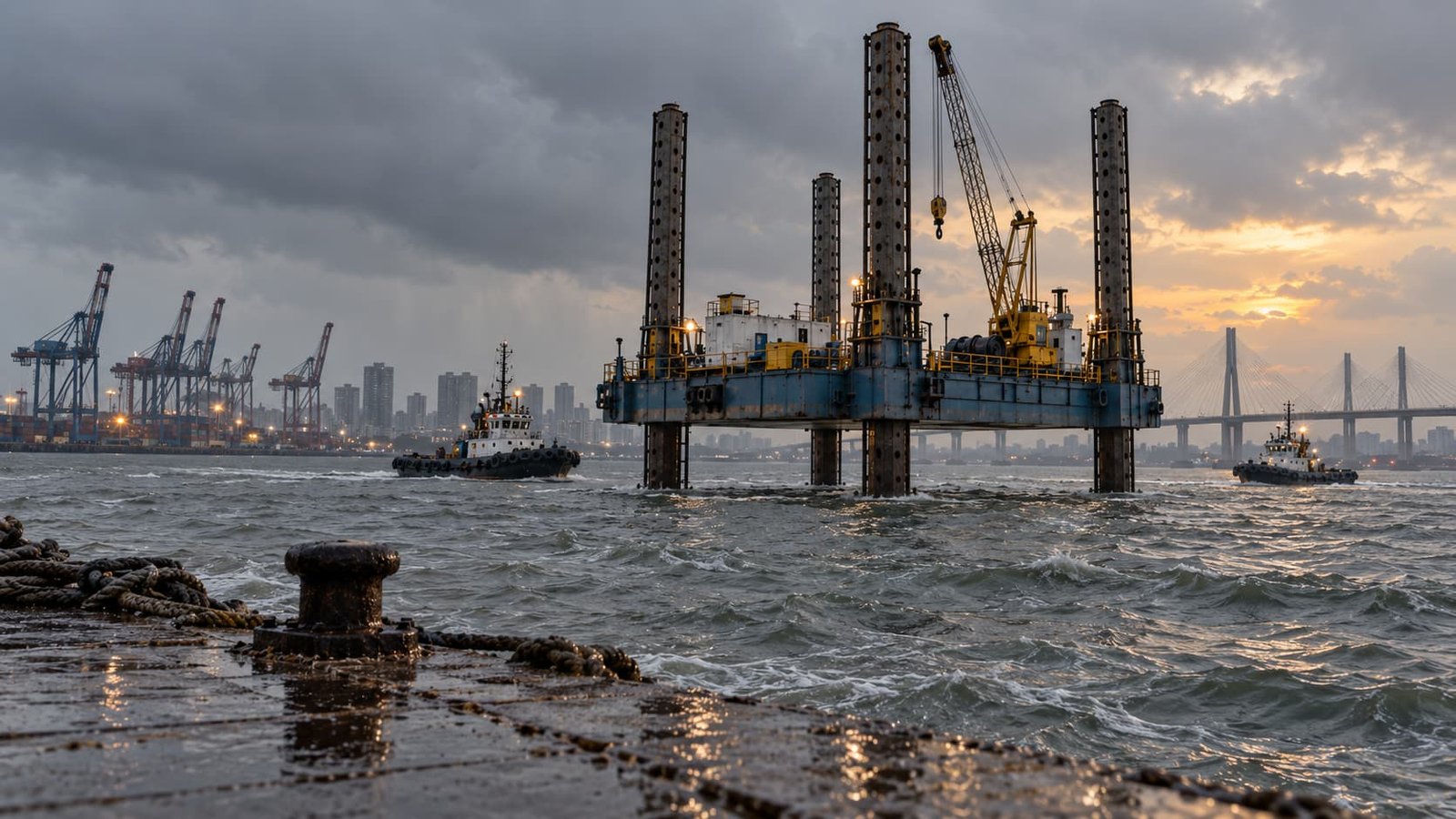
A jacking procedure that works perfectly in January can be the wrong call entirely by June. Mumbai’s harbour doesn’t just get wetter during the monsoon, it changes tidal behaviour, current strength and seabed conditions enough that a crew running on last season’s assumptions can find themselves caught out.
This guide looks at what’s actually different about operating a jack-up barge in Mumbai specifically, covering tidal range, the monsoon working window, local seabed conditions and what that means for day to day planning. It builds on our earlier guides on how a jack-up barge works and jack-up barge preload, which this local context applies directly to.
Why Mumbai’s harbour needs its own planning approach
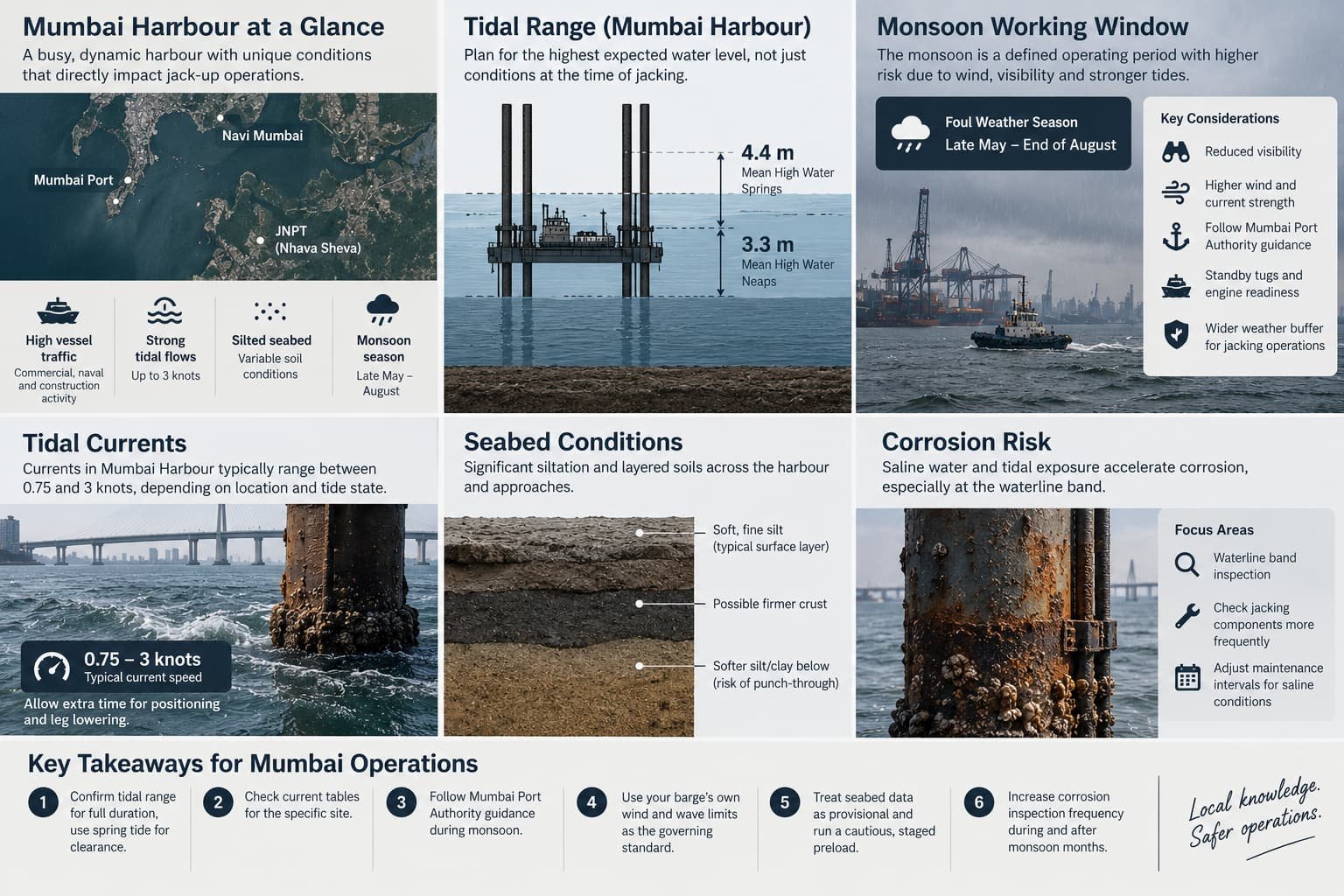
Mumbai Harbour sits on India’s west coast and handles a mix of port traffic, naval activity and marine construction across Mumbai Port, Jawaharlal Nehru Port at Nhava Sheva, and the smaller creeks and jetties along Navi Mumbai and Thane. That mix means jacking operations here run alongside heavy vessel traffic, strong tidal flows and a seabed shaped by decades of siltation, none of which show up in a generic operating manual written for open water.
Two factors do most of the work in making Mumbai distinct: the tidal range, which is large enough to matter for jacking clearance, and the monsoon, which doesn’t just bring rain but genuinely changes what’s safe to attempt on the water.
Tidal range and what it means for jacking clearance
Mumbai Harbour’s tidal rise reaches roughly 4.4 metres at mean high water springs and around 3.3 metres at mean high water neaps. That’s a substantial swing, and it directly affects how much air gap a jacked-up barge needs to clear the highest expected water level during a job, not just the water level at the moment jacking began.
A barge jacked up during a neap tide and left standing into a spring tide cycle needs clearance calculated against the higher spring range, not the conditions present when the legs went down. Getting this wrong doesn’t cause an immediate problem the way punch-through does, but it erodes the safety margin the jacking plan was supposed to provide in the first place.
Tidal currents and leg lowering
Current speeds within Mumbai Harbour typically run between roughly 0.75 and 3 knots, depending on location and the state of the tide, and they’re strong enough to push on a barge’s legs while they’re being lowered, before the spud cans have found a stable footing. That lateral load during lowering is one of the failure modes we flagged in our guide on how a jack-up barge works, and it’s a genuinely local risk here rather than a generic caution, since Mumbai’s currents sit well above what a sheltered inland site would present.
Positioning and holding the barge steady against this current before and during leg lowering matters more here than it would in calmer water, and it’s worth building extra time into the schedule for this step rather than treating it as routine.
Planning jacking operations around Mumbai’s monsoon season
Mumbai’s monsoon isn’t a minor seasonal inconvenience for marine work, it’s a defined operating period with its own guidance from the Mumbai Port Authority. The foul weather season typically runs from late May to the end of August, and during this window the harbour sees its strongest tides alongside greater wind and visibility risk.
Port guidance during this period restricts anchorage to a defined foul weather limit line and calls for standby tugs, engine readiness and extra mooring provision for vessels in the harbour. None of that guidance is written specifically for jack-up barges, but the underlying caution applies just as directly: a jacking operation in reduced visibility, strong current and unpredictable wind carries meaningfully more risk than the same operation run in November.
Reading harbour guidance against your own barge’s limits
Port authority circulars set general vessel safety thresholds, not jacking-specific ones, so the right approach is to treat them as a floor rather than a complete answer. A barge’s own documented wave height and wind limits, set by its classification and design, should always be the stricter of the two during monsoon planning. If port guidance would allow an operation that exceeds your barge’s own stated limits, the barge’s limits govern, not the general circular.
Practically, this means monsoon-season jacking in Mumbai needs a wider weather buffer than the same job planned for the post-monsoon working season, and a jacking schedule that assumes monsoon-season reliability equal to the rest of the year is planning against the wrong baseline.
Seabed conditions across Mumbai’s harbour and approaches
Mumbai’s harbour bed carries significant siltation, built up continuously by river discharge and tidal action, which is why maintenance dredging runs on a recurring schedule at berths and channels across the port rather than as a one-time job. For a jack-up barge, that siltation generally means a softer, finer-grained seabed than a crew might expect from a site further offshore, and it reinforces exactly the layered-soil risk covered in our guide on preload and punch-through.
A crust of firmer material sitting over softer silt underneath is a realistic scenario at several points across the harbour and its approaches, which makes a careful, staged preload every bit as necessary here as the general guidance suggests, if not more so given how variable siltation depth can be between seasons.
Corrosion in Mumbai’s saline harbour conditions
We touched on saline corrosion in our maintenance guide, and Mumbai’s harbour is a direct example of the conditions that guidance was written for. Constant exposure to saline water, combined with the mechanical stress of tidal current on legs and jacking components, accelerates corrosion at the waterline band faster than fresh water conditions would. A maintenance interval copied from a manufacturer’s generic schedule, rather than adjusted for local saline exposure, risks missing corrosion that’s progressing faster than the schedule assumes.
A seasonal checklist for Mumbai operations
- Confirm the tidal range for the full duration the barge will stand jacked up, not just conditions at the time of jacking
- Check current state tables for the specific berth or site, since velocity varies across the harbour
- Cross-check planned operations against the current foul weather season dates and Mumbai Port Authority guidance
- Apply your barge’s own documented wind and wave limits as the governing standard, especially during monsoon months
- Treat seabed data as provisional where siltation is active, and budget extra time for a cautious, staged preload
- Increase waterline corrosion inspection frequency during and after monsoon months rather than waiting for the standard interval
FDC operates its fleet, including AQUAQUEEN, AMIT, PRIDE 1, SANGAM 2 and AQUASTAR, directly out of Mumbai, with crews and shipyard support in Belapur, Navi Mumbai familiar with these local tidal, seabed and seasonal conditions. For technical guidance on a specific site or job, call 98677 00755 / 93218 44408 or email famous2131 [at] gmail.com.