Jack-up barge jacking system maintenance and inspection: What technicians need to check
Published on October 5, 2026 by Famous Dredging Corporation

A jacking system rarely fails without warning. It fails after weeks or months of small signs that nobody logged carefully enough to notice the pattern: a slightly slower jacking speed, a hydraulic top-up that happened more often than last month, a pin that needed a bit more persuasion to seat. None of those stop a job on their own, until the day they do.
This guide sets out what to inspect on a jack-up barge jacking system, how often, and what early wear actually looks like before it becomes a breakdown. It builds on our guides on how a jack-up barge works and jack-up barge preload, which cover the mechanism and operation this maintenance keeps reliable.
Why Jack up barge jacking system maintenance is different from general vessel maintenance
Most marine maintenance deals with continuous wear: hull corrosion, engine hours, running gear. A jacking system wears differently, because its hardest-working components only move during the few hours of jacking up and jacking down on each job. That intermittent use means problems can sit undetected for a long time between inspections, since the pins, racks or hydraulic seals aren’t visibly in motion most of the time a barge is in service.
It also means the stakes are higher than they first appear. A gradual engine problem usually gives a vessel time to limp to port. A jacking system fault during an actual jacking operation, with the hull partway between floating and standing, offers much less room to respond.
What to inspect on a hydraulic jacking system
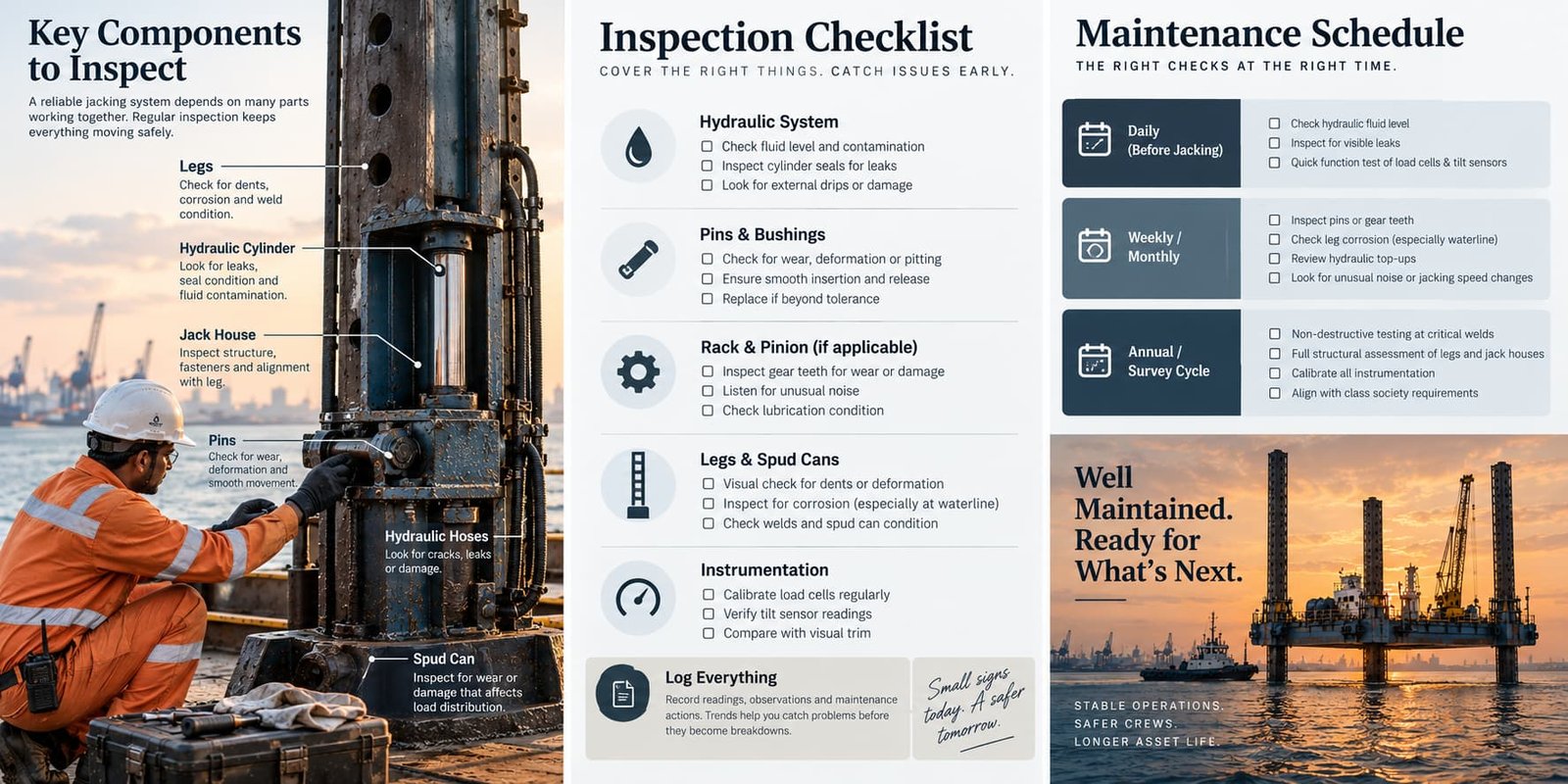
Hydraulic pin and cylinder systems depend on seal integrity and fluid condition more than almost anything else. Technicians should check hydraulic fluid for contamination, since water ingress or metal particles in the fluid point to a seal or filtration problem developing elsewhere in the system. Cylinder seals themselves need a visual check for leakage at the rod, and any external drips noted during a previous jacking operation should be followed up specifically rather than assumed resolved.
Pin condition matters just as much as the hydraulics driving them. Pins should move freely into their holes without excessive force, and any pin showing visible wear, deformation or surface pitting needs closer assessment before the next jacking operation, not after it.
What to inspect on a rack and pinion jacking system
Rack and pinion systems shift the inspection focus toward gear condition. Technicians should check rack and pinion teeth for wear patterns, pitting or chipping, since uneven tooth wear often signals a meshing or alignment problem rather than simple age. Motor and gearbox condition deserves the same attention, including listening for unusual noise during jacking operations, which frequently shows up before any visible wear does.
Lubrication matters more here than on a hydraulic system, since dry or contaminated lubrication accelerates gear wear quickly. A lubrication schedule that’s followed consistently is one of the simplest ways to extend gear life on this type of system.
Leg and structural inspection
| Check | What it reveals |
|---|---|
| Visual check for dents or deformation | Impact damage that reduces a leg’s load-carrying capacity |
| Corrosion inspection, especially at the waterline band | Section loss that weakens the leg over time, worse in saline conditions |
| Weld inspection at leg and spud can joints | Fatigue cracking at high-stress connection points |
| Non destructive testing at critical welds | Subsurface cracking not visible to a routine visual check |
| Spud can condition | Wear or damage affecting how load spreads into the seabed |
Instrumentation: load cells and tilt sensors
A jacking system is only as trustworthy as the readings a crew relies on during preload and jacking. Load cells measuring leg reaction force need periodic calibration against a known reference, since a drifted load cell can mask a genuine punch-through warning or, just as dangerously, trigger false alarms that crews start ignoring. Tilt sensors need the same discipline. A sensor reading a few degrees off during jacking can hide a real list developing in the hull until it’s visible to the eye, well past the point an accurate sensor would have flagged it.
Building a maintenance schedule that actually gets followed
None of the checks above help much if they exist only as a policy document nobody consults. A schedule that survives contact with a busy job calendar needs to be realistic about what gets checked when.
Setting inspection intervals
Daily checks before any jacking operation should cover hydraulic fluid level, visible leaks, and a quick function test of load cells and tilt sensors. Weekly or monthly checks, depending on how frequently the barge jacks, should extend to pin or gear tooth condition and a closer look at leg corrosion, particularly around the waterline band where saline exposure does the most damage. Annual or survey-cycle checks, aligned with classification society requirements, should include non destructive testing at critical welds and a full structural assessment of the legs and jack houses.
In Mumbai’s harbour and coastal conditions specifically, saline exposure accelerates corrosion on exposed steel faster than in fresh water, which is reason enough to run the waterline corrosion check more frequently than a generic manufacturer schedule might suggest, rather than waiting for the next scheduled survey to catch it.
Keeping a maintenance log that’s actually useful
A maintenance log earns its value when it records trends, not just pass or fail results. Logging specific readings, hydraulic fluid top-up volume, pin insertion force, gear noise observations, lets a technician spot a slow deterioration over several jacking cycles that a single inspection would miss entirely. A log that only records “checked, OK” loses that early warning capability completely.
Common early warning signs worth acting on
- Jacking speed noticeably slower than the barge’s normal baseline
- Hydraulic fluid needing top-up more frequently than previous months
- Unusual noise from gears or motors during jacking that wasn’t present before
- Pins requiring more force to seat or release than usual
- Load cell or tilt sensor readings that don’t match a visual check of the barge’s actual trim
- New corrosion staining or surface pitting since the last inspection
Any one of these on its own might be minor. Several appearing together, or the same one repeating across consecutive jobs, is the pattern worth stopping to investigate before the next jacking operation rather than after.
When to take a jacking system out of service
A jacking system should come out of service for repair when a pin, gear or hydraulic component shows wear beyond the manufacturer’s tolerance, when a load cell or tilt sensor can’t be calibrated back to an acceptable accuracy, or when non destructive testing reveals a weld defect at a leg or spud can connection. Continuing to operate past any of these points shifts risk onto the next jacking operation, at a point in the job where there’s far less room to respond safely.
FDC’s in-house shipyard in Belapur, Navi Mumbai handles jacking system repair, pin and rack replacement, and structural leg inspection across its fleet, including AQUAQUEEN, AMIT, PRIDE 1, SANGAM 2 and AQUASTAR. For maintenance support or to schedule an inspection, call 98677 00755 / 93218 44408 or email famous2131@gmail.com.